Thursday, June 7, 2012

Jodi Colella


In the Beginning


    “My work references the biological world, uses found and manufactured materials, and incorporates a methodical and meditative work practice.
I create structures that can act as metaphors for being human often taking on anthropomorphic gestures and emotions. I want to inspire questions about where an individual ends and the world begins.
     Found fishing ropes morph into nerve capillaries, tubes of screen congregate
into honeycomb, and wool grows from the crevices of driftwood - as if creating new species. It is my goal to engage - to create a physical attraction that beckons
one to want to touch and BE touched by what they see.”

                                                  Jodi Colella


Hive

 
     Jodi Colella is a mixed media sculptor and teacher who explore the character of the materials while creating abstractions of natural forms and transforming ordinary materials into the unexpected. Her nimble mind and nimble fingers have produced an array of compelling sculptures. She uses traditional crafting techniques such as crochet, knitting, felting and embroidery to create structures that are anything but traditional. The needle felted and found driftwood sculptures pictured here mimic organic patterns found in science.


Diana                                         Colony


     The artist, who has a degree in Biology from Boston University was originally a researcher at the Dana Farber Cancer Institute in Boston, but did not feel the career was the right fit for her. She got a certificate in Graphic Design in 2000, and worked in the field for a while before she gave that up to pursue her own art. Colella describes herself as an intuitive artist, and trusts that intuition implicitly.


Receptor                                            Nuclei I


     Humans are tactile beings. Our fingers seem to be drawn to materials, be they smooth as silk or rough as bark. Jodi Colella's fingers have a restless curiosity, not content to let the transformative potential of materials they touch lie dormant. A Somerville-based fiber artist who's as fascinated by her process as she is by its outcome, Colella sees the bizarre and enticing capabilities of the substances she works with. "I'm very curious about materials," she says. "Just playing with them to find their qualities. Usually they do unexpected things."


Seeds


     Her inquisitiveness comes in part from a love of nature's building blocks. "Aesthetically, I have always loved cellular forms. In fact, if you look at my notebooks from back then," she laughs, referring to her days studying biology at BU, "I didn't write too much information, but I had all the images." Seeds and Nucleus are recent works of Colella's that evokes biological forms but are rooted in textile traditions too. She experimented with needle felting (a method of transforming wool fleece into felt), creating dysmorphic orbs of burred fuzziness and vivid layers of color. The process signified concentrated potential, each needle prick a compacting of Colella's own energy into the "seed."


Epithelia                                             Lichen 


     Colella first encountered traditional textile methods like felting and knitting during summers at her grandparents' home on Cape Cod. "I was brought up always working with my hands," notes the former graphic designer, "and I've always loved doing that. So I think that's where I start, and then hopefully it goes somewhere else." While fleece is a conventional material, Colella's fingers often reach for things that stretch the definition of fiber, such as window screen that she's used to make Undercurrent, a work about barriers and duplicity.


Undercurrent


     Like many artists in our creative environs she wears many hats. She teaches at the deCordova museum in Lincoln, Mass, working with students with fiber art and sculptural jewelery. As a teacher, she helps students develop their art, from fiber to sculptural jewelery. Patience, she says, is the key. "It's very difficult to be in the position of trying to figure something out but you can't. And to have somebody show you, or indicate a way that you can figure it out yourself that makes you feel good is really important. There's just a level of fulfillment there in people sharing with you, you sharing with people." It's easy to imagine a student of Colella's catching her fervour for experimenting with materials. "Very often," she says, eyes twinkling, "you get these surprises that are nothing you would ever dream of. That's what I love about it."


Marrow                                                  Blast

 
     Jodi Colella shapes constructions that mimic the patterns of science while observing the inherent character of materials, transforming them from the ordinary to the unexpected. The results are both beautiful and full of contradictions, monumental and delicate, organic and man made. Jodi's work has exhibited nationally in museums and galleries winning several awards including from The Textile Center Minneapolis, New Fibers 2010 and will be included in "GREEN: a Color and a Cause" at The Textile Museum in Washington D.C.


What Looks Like an Elephant                    /detail/


Nuclei III


Mushroomed                                              /detail/


Jodi Colella


Sunday, April 15, 2012

Judith Content


Leaves Fall, Feathers Float, Fish Swim Upstream


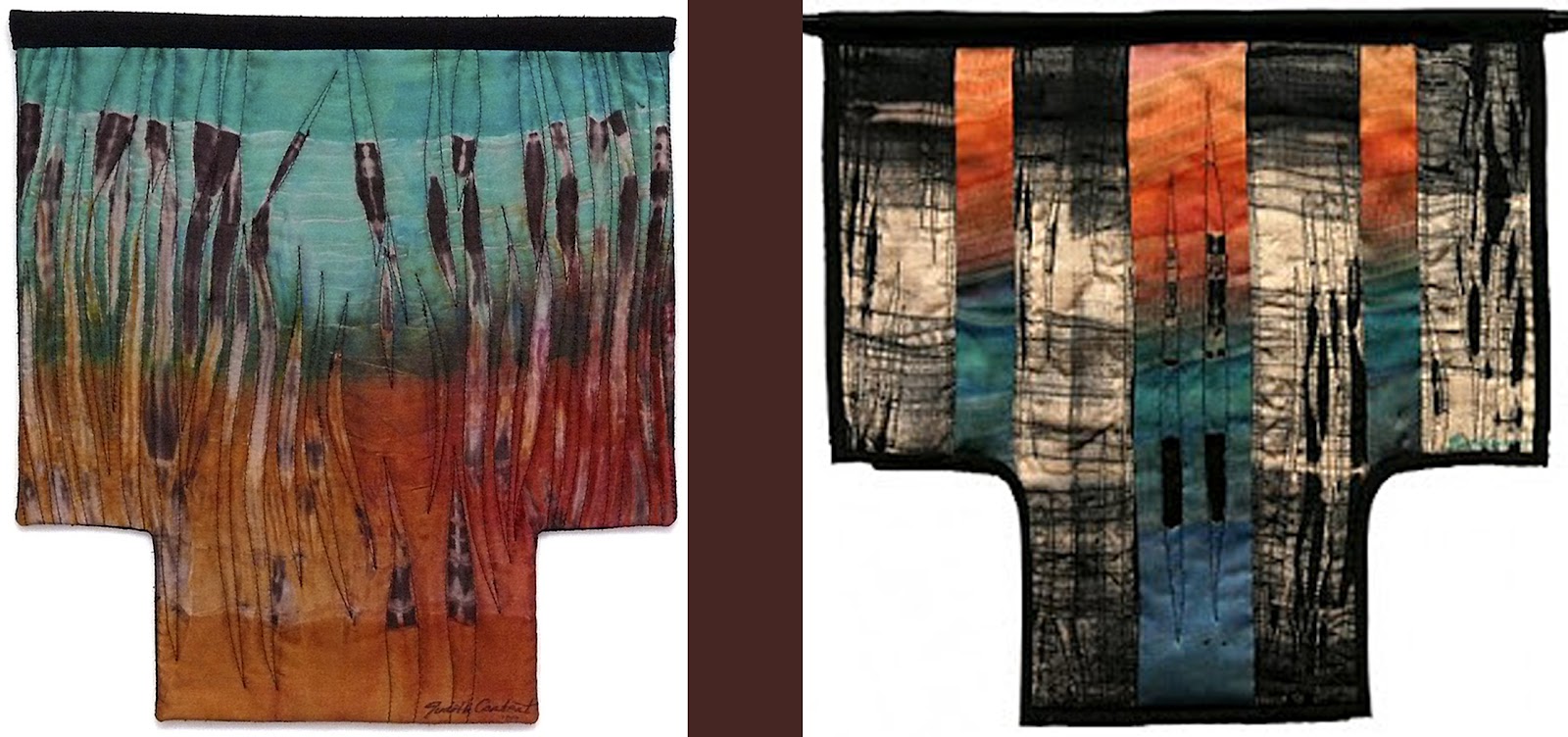
     Judith Content is a fiber artist from Palo Alto, California, who utilizes a contemporary interpretation of the Japanese dye technique, Arashi-Shibori. Her hand-dyed, quilted, and pieced silk wall pieces often depict elaborate landscapes that are inspired by the mystery and majesty of the Pacific coastline.
     Content has been an artist for more than thirty years, starting with training in painting to being a student of Japanese shibori and branching out to many other mediums.  Highly skilled in the dyeing arts, Judith has developed her own arashi (pole wrapping) shibori technique that subtracts and adds color, which she uses to constructs large kimono-shaped wall panels with a palette of various silk fabrics. This approach produces a unique and calming effect, attractive to the eye, regardless of the piece’s size.


                                                                 Sumie and Snow


     As this technique is practiced in Japan, fabric was tightly wrapped and compressed on long polished wooden poles. The poles were then submerged in vats of indigo dye. The threads used to secure the fabric to the pole as well as the manipulated pleats resist the penetration of dye. Patterns reminiscent of wind- driven rain emerged from this process. Perhaps this is why the dye process was named arashi, which translates as the word “storm” in Japanese.


Torrent


     For over 30 years, Content has been exploring and refining this dye technique, creating a contemporary approach to an ancient technique. She has devised her own ways of wrapping and applying the dye. Over the years Judith Content has refined several unique approaches of the traditional arashi-shibori. Rather than indigo she uses a broad spectrum of the beautiful Japanese “miyakozome” dyes to create a collection of silks just as a painter would mix their paints. Judith also at times removes layers of color through delicate bleaching processes for even more intricate colorations. This process creates subtle gradations of color that merge and morph into each other. The viewer cannot always tell when and how one color becomes another. Although she can control the results to a great extent, Content states “the element of surprise when the silk is unwrapped and the patterns are revealed never fails to excite me.”


Sweltering Sky                        La Briere


     During the summer of 2010 when Content visited the Bosque del Apache National Wildlife Refuge in New Mexico she was drawn to the mission of their Watershed Educational Project which she describes as “an exciting exploration of river ecology, riparian/wildlife habitat, cultural traditions of New Mexico and the restoration efforts of this vital wetlands, at home in a desert landscape. Exploring the deep water marsh on boardwalks and trails I was mesmerized by the sensation of reeds and grasses towering overhead, their graceful silhouettes reflected in the water at my feet. The experience gained an element of mystery when the sky grew dark and rain poured down. This morphed to exhilaration when the sun came out, mirroring the sky on water droplets balancing on the blades of marsh grasses.” Content knew this strange and new environment would find its place in her future projects.


Calligraphy


     Judith says of her marriage of technique and narrative: “By integrating technique and vision I hope to evoke a mood, create a feeling or stir a memory that resonates in a deeply personal way with the viewers of my art. I am passionate about the process involved in my work and relish the labor of its creation.” Her work captures a moment in time and freezes it so the artist and the viewer can return and each time find new colors and ways in which they interact with one another. The experience takes one on a familiar journey that is seen newly each time. Content’s handling of light and dark, brilliant color juxtaposed to the most subtle of hues, and the interaction of natural light coupled with the size of her pieces envelop the viewer in a unique experience.


Portal  


     Like the Japanese haiku her work explores the essence of an image, a memory, or a moment in time. She finds inspiration in nature’s waterways, from coastal estuaries to desert pools. She is especially drawn to the haunting beauty of fens and marshes and the relationship between light and shadows as atmospheric changes abstract the landscape.


Precipice                                  Chazm


     A full-time studio artist for more than twenty years, Judith Content has shown nationally in exhibitions such as Visions and Quilt National as well as internationally in Japan, Indonesia, the United Kingdom, Canada, Belgium and France. Her work is represented by several galleries nationally, and her most recent solo exhibition was at Thirteen Moons Gallery in Santa Fe, New Mexico in 2004. She has work in the permanent collection of the Fine Arts museums of San Francisco, the Museum of Contemporary Arts and Design, New York, NY, and the International Shibori Collection belonging to the city of Nagoya, Japan. Publications include "The Art Quilt" by Robert Shaw, "The Kimono Inspirations: Art and Art to Wear in America" by Rebecca A.T. Stevens, "Memory on Cloth: Shibori Now" by Yoshiko I. Wada and "Artwear: Fashion and Anti-Fashion" by Melissa Leventon. 


Rain Shadow


     Judith is currently on the Board of Directors of the Studio Art Quilt Association, and served three years on the board of the Textile Arts Council of the Fine Arts Museums of San Francisco, CA. She has served several terms on the Foundation Board of the Palo Alto Art Center in California where she continues to volunteer.


Tempest                         Ocean of Storms


Luminaria


Vernal Pool


Tule Fog                                Prism


Cenote  Turquesa


Judith Content